
The verdict marks a notable shift from a series of recent wins for Trump at the Supreme Court.

US and India will promptly implement this framework and work towards finalising the interim agreement with a view to concluding a mutually beneficial bilateral trade agreement.

The textile and apparel sector is India's second-largest employment provider, after agriculture, and it is now caught in a wave of uncertainty following the Donald Trump administration's tariff policy.
The country's exports rose marginally by 0.61 per cent to $36.56 billion in January, while trade deficit widened to a three-month high of $34.68 billion, government data showed on Monday.

The ruling is expected to have wide-ranging consequences for global trade, businesses, consumers, inflation trends and household finances across the country.

India and the European Union are set to announce on January 27 the conclusion of negotiations and finalisation of a free trade agreement, which is aimed at boosting economic ties between the two regions amid disruptions in global trade due to US tariffs, an official said.

In order to modernise the Indian textile industry, the finance minister has increased the allocation to the Technology Upgradation Fund Scheme (TUFS) by 188 per cent to Rs 3,140 crore (Rs 31.40 billion) for 2009-10 as against Rs 1,090 crore (Rs 10.90 billion) for the corresponding period last year.

New Delhi will substantially reduce tariffs on industrial and agricultural goods while continuing to protect sensitive sectors. Tariffs on some agricultural products that are not traditionally considered sensitive will be brought down to zero, while in the case of relatively sensitive items, duties will be reduced in a graded manner and quotas will be imposed.

Both countries commit to provide each other preferential market access in sectors of respective interest on a sustained basis

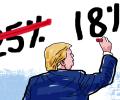
Domestic equities surged on Tuesday, posting their best single-day gains in more than eight months after a long-awaited trade deal between India and the US. The deal, which lowered tariffs on Indian goods to 18 per cent from 50 per cent, significantly improved investor sentiment and lifted a key overhang for the market.

Textile stocks have exhibited a mixed performance so far this calendar year (CY23), amidst higher domestic cotton prices and tepid global demand. Shares of Page Industries, Dollar Industries, Lux Industries, and VIP Clothing have declined up to 13 per cent so far in CY23, as against a 9 per cent jump in the S&P BSE Sensex. On the contrary, shares of Arvind, Welspun India, Raymond, and Gokaldas Exports have gained up to 51 per cent, during the same period.

The government's Budget announcements providing tax holiday for data centres, setting up of city economic regions (CERs) and funding to improve infrastructure in Tier-II and -III cities may give an indirect boost to India's realty sector, said industry executives.

The agreement addresses non-tariff barriers and promotes increased trade in technology products and cooperation between the two countries.

Technology Innovation: Sword or Plough looks at key moments in recent history, noting how key technological changes at pivotal moments had unimaginable consequences, both positive and negative. It makes for enjoyable and insightful reading.
The government on Thursday said textile industry, facing the challenges of the post quota regime, has shown encouraging signals clocking 14.8 per cent growth in the first three quarters of this fiscal, but easing of entry-exit norms would further ben
Amit Goyal, president, Confederation of Indian Apparel Exporters, plans to reduce the number of companies his group Sarju International

New Zealand Prime Minister Christopher Luxon on Monday said the negotiations for a free trade agreement with India have been concluded.
The escalating trade war between the US and China is expected to benefit Indian exporters in increasing their shipments to the American market, according to experts. Federation of Indian Export Organisations (PTI) President S C Ralhan said that imposition of higher tariffs by the US on China will shift demand towards India, which exported goods worth Rs 86 billion to the US in 2024-25.

Wholesale price inflation extended upward momentum for the second straight month, recording at 0.83 per cent in December 2025, driven by an uptick in prices of food, non-food articles, and manufactured items on a month-on-month basis, government data showed on Wednesday. Wholesale Price Index (WPI)-based inflation returned to positive in December, after witnessing a deflationary trend in the previous two months.

Withdraw mandatory excise duty of 10 per cent on branded garments and made ups while continuing optional routes for all segments in the textile and clothing sector.

Uttar Pradesh's leading export hubs are reeling under the impact of a steep 50 per cent tariff imposed by the US on Indian imports, with exporters warning of job losses, stalled orders and shrinking market access. Industry leaders from Noida, Kanpur and Varanasi said the tariff has put years of painstaking market-building at risk, even as protests and demonstrations erupted in several districts last week.
'Trump says India will buy over $500 billion of US goods.' 'At present, India's annual imports of goods and energy from the US are under $50 billion.' 'Reaching $500 billion would likely require more than 20 years, suggesting the figure refers to a long-term aspiration rather than a near-term commitment.'

'This has translated into a combined daily loss of 60 crore in revenues for exporters in Tiruppur, Coimbatore, Erode and Karur districts, pushing many small and medium enterprises to the brink of collapse.'
This comes in the background of claims by the Confederation of Indian Textile Industry, an industry body, that about 700,000 jobs have been cut in the last six months. The industry lobby group has also forecast a further loss of half a million jobs in the next five months.

'Only four or five original companies remain; the rest have been replaced every decade as sectors evolve or leadership shifts.' 'Companies that fail to adapt -- like many textile mills from the 1970s and shipping firms from the 1980s -- disappear.' 'Benchmark indices reward those who reinvent themselves in line with economic demands.'

Budget 2026 sticks to fiscal discipline, shuns populist measures despite five key state elections coming up, but ends up rattling stock markets with a higher transaction tax on derivatives trading.
The government is planning to set up 25 integrated textile parks with an aim to enhance the competitiveness of the textile industry.

Reiterating Sitharaman's statement that this is a youth power budget, Modi emphasised that the provisions made in the budget will prepare leaders, innovators and creators across different sectors.

India and Russia are expected to sign a bilateral mobility agreement during President Vladimir Putin's visit to New Delhi, establishing a framework for legal migration, worker protection, and expansion of skilled Indian manpower in Russia.
Since September last year, when everyone realised that the global economic meltdown could not be wished away, industry groups have been dishing out data on job losses. Among these is the Confederation of Indian Textile Industry, which said a million jobs had been lost in the last financial year. Most textile companies expect the situation to improve by October this year.

From labelling India the 'Tariff King' to slapping sweeping import duties, US President Donald Trump has steadily hardened his trade stance on India. These announcements are being seen as a pressure tactic to get New Delhi to agree to demands made by the US in the proposed Bilateral Trade Agreement (BTA).

Next week's three-nation foreign tour of Prime Minister Narendra Modi will see India and Oman sign a free trade deal. The visit will also pave the way for agreements with Ethiopia and Jordan to increase India's bilateral trade and investments.

Exemption of excise and customs duty on liquid fuels, abolition of service charge, rescheduling of loans for all textiles and clothing units will reduce pressure on the industry and will help to improve liquidity.

Indian companies feel it will be difficult to take on the competition from Bangladesh, Cambodia and others, with their made-in-India products. Ethiopia offers ready-to-use sheds, income tax breaks, training subsidies, and a tax-free gateway into the US, Europe and China. Moreover, labour is available for $60 per month compared to $130-$150 in India.

The country's textile industry is concentrated in a few pockets of Gujarat and Maharashtra in the west and Tamil Nadu and Karnataka in the south.

Usually, in the western view, corporate success is attributed to efficiency, organisational structure, and scale. R Gopalakrishnan and Harish Bhat argue that philosophy, culture, and the transmission of values are more important for sustaining growth and profitability of an enterprise over a period of time.
The Indian Textile Industry is currently one of the largest and most important industries in the Indian economy in terms of output, foreign exchange earnings and employment.
 © 2026 Rediff.com - Advertise with us - Disclaimer - Privacy Policy - Sitemap - Feedback - About us - Terms of use - Grievances